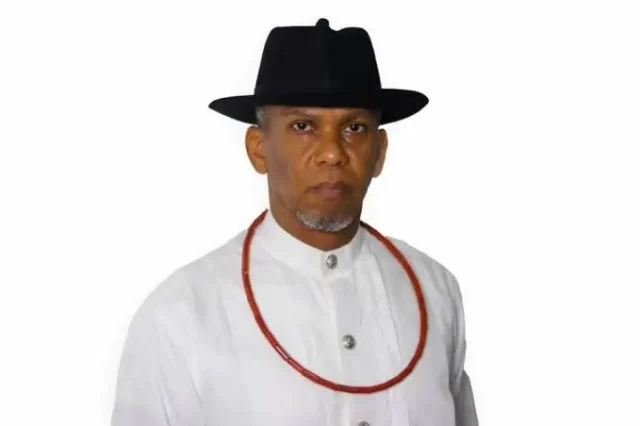

A group of Urhobo leaders has rejected attempts to frame the Delta Central senatorial contest along an “Eastern” and “Western” divide, insisting that equity must be based on federal constituency rotation rather than what they described as “outdated and misleading classifications.”

The leaders, in a joint statement, were reacting to an article by Chief Williams Makinde titled “OMO-AGEGE IS ON TRACK AND WILL CONTINUE TO WORK FOR ALL URHOBO,” which itself responded to an earlier intervention by Chief Julius Eguvwebere.

They argued that any credible conversation on fairness must reflect the present political structure of Delta Central, which comprises three federal constituencies—Ughelli North/Ughelli South/Udu; Okpe/Sapele/Uvwie; and Ethiope—rather than historical blocs.
The statement was jointly signed by Chiefs Philip Eyagomare, Dave Emaniru, Goddy Otubuere, Tony Erukeme, Tony Onyokoko, Archbishop Philip Orovwuje and Sir Henry Esiri.
According to them, “the attempt to revive colonial-era classifications is not only inaccurate but irrelevant in today’s political reality.”
The group maintained that available records show a clear imbalance in representation, noting that the Ughelli/Udu axis has dominated the senatorial seat since 1999.
They pointed out that Ughelli North alone, particularly Constituency I, has produced senators for about 12 years, while Ughelli South and Udu have also had their turns, bringing the total for that bloc to roughly two decades.
In contrast, they said the Okpe, Sapele and Uvwie axis has held the position for only about seven years, describing the disparity as a “fundamental issue of justice.”
“Equity demands fairness, not the recycling of power within the same bloc that has already benefited the most,” the statement read.
The leaders also faulted claims that political positions should be determined by kingdom considerations, insisting that both senatorial and governorship positions have historically been rotated along senatorial districts, local governments and federal constituencies—not traditional institutions.
They questioned the logic of denying certain areas opportunities based on such arguments, warning that it could deepen division rather than foster unity.
On the 2023 political dynamics, the group clarified that decisions taken by key actors, including Olorogun O’tega Emerhor, were based on strategic considerations within the same state constituency—not any East-West arrangement.
They further raised concerns over what they described as a lack of reciprocity in leadership, calling on former Deputy Senate President, Senator Ovie Omo-Agege, to support the emergence of new leaders across the district.
“Leadership must not become a one-way street where the aspirations of many are continually sacrificed for one individual,” they stated.
Drawing parallels with past political figures, the group highlighted the roles played by leaders such as Chief James Ibori and Chief Great Ogboru in mentoring and promoting others, urging Omo-Agege to adopt a similar approach.
“True leadership is measured not just by personal success, but by the ability to raise others who may even surpass you,” they added.
The statement warned against what it described as growing self-preservation among political actors, calling instead for statesmanship and inclusiveness.
According to the signatories, the future of Delta Central politics must be anchored on fairness, balance and collective progress, with deliberate efforts to support underrepresented constituencies.
“The time has come to move away from outdated narratives and embrace a more equitable framework that gives every segment a genuine sense of belonging,” they said.