
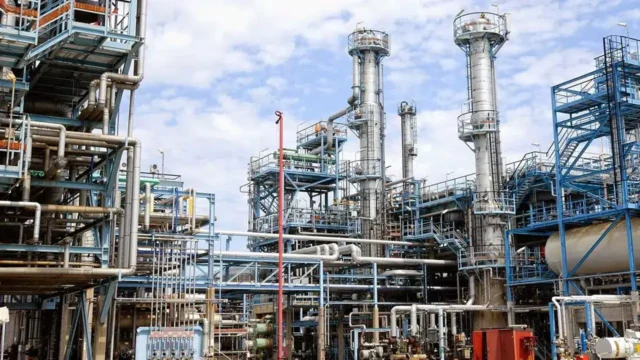
In a renewed push to fix Nigeria’s struggling refining sector, the Nigerian National Petroleum Company Limited has signed a Memorandum of Understanding with two Chinese firms to restart, operate and expand the Warri and Port Harcourt refineries.
The agreement, signed in Jiaxing City, China, brings in Sanjiang Chemical Company Limited and Xingcheng (Fuzhou) Industrial Park Operation and Management Co. Ltd as prospective technical partners in a deal aimed at rescuing Nigeria’s ailing refining infrastructure.
NNPC’s spokesman, Andy Odey, said the MoU will pave the way for a Technical Equity Partnership designed to complete stalled rehabilitation works and ensure efficient, long-term operations of the facilities.
The deal was executed on April 30, 2026, by NNPC Group Chief Executive Officer, Bashir Bayo Ojulari, alongside top executives of the Chinese firms.
Under the arrangement, the partners are expected to support the completion of rehabilitation at both plants, while also participating in their operation and maintenance to guarantee sustainable performance.
Beyond rehabilitation, the partnership will explore refinery expansion, upgrades to meet cleaner fuel standards, and increased petrochemical output. It will also target the development of gas-based industrial hubs around the facilities—an area seen as critical to Nigeria’s industrial growth.
Ojulari described the agreement as a “major milestone,” noting that it followed months of negotiations and reflects a shared commitment to unlocking value in Nigeria’s refining assets.
Industry watchers say the move signals a fresh attempt by NNPC to overcome persistent setbacks that have plagued the refineries despite billions of dollars committed to their revival.
The Port Harcourt Refining Company, which underwent a $1.5 billion rehabilitation approved in 2021, had briefly resumed operations in late 2024 before shutting down again due to operational and financial challenges.
Similarly, the Warri Refining and Petrochemical Company is being rehabilitated under an $897 million contract aimed at restoring its 125,000 barrels-per-day capacity and boosting petrochemical production.
Both refineries are central to Nigeria’s long-standing ambition to reduce dependence on imported fuel—a goal that has remained elusive for decades.
Despite the optimism, NNPC cautioned that the agreement remains non-binding and subject to regulatory approvals and further negotiations.
Still, the deal underscores growing reliance on foreign technical expertise as Nigeria races to revive dormant assets and stabilise its downstream oil sector.


